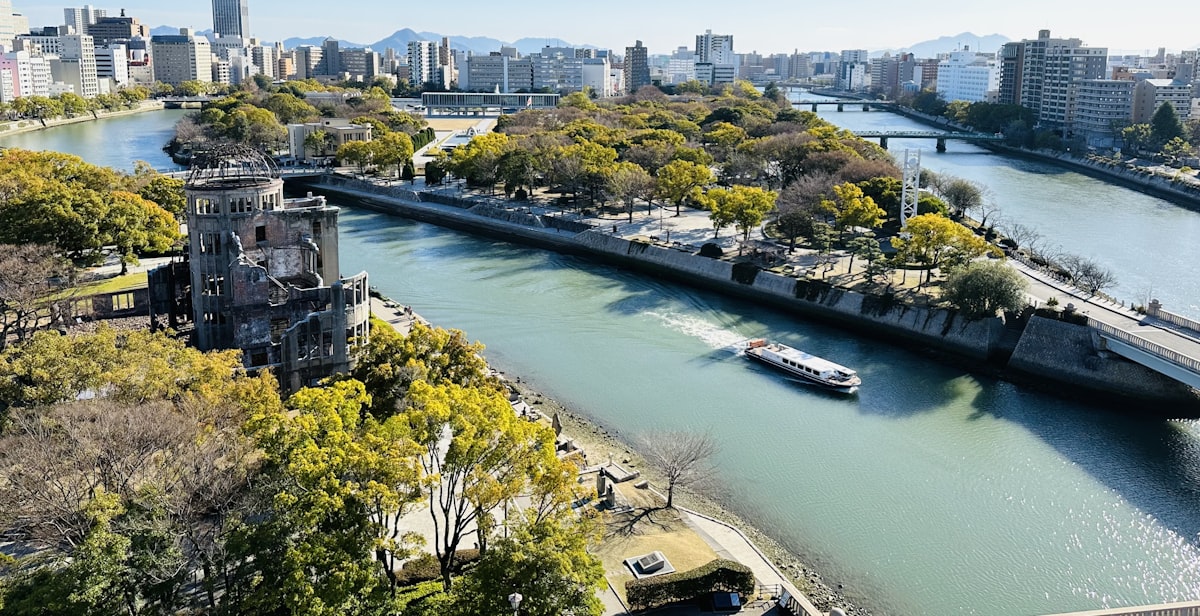
Hiroshima 3-day, 2-night family course to teach children about peace

📅 2 nights 3 days Easy 💰 Budget 📝 2026-02-09

Hiroshima is a special travel destination that can teach children the importance of peace.

Learn history at the Atomic Bomb Dome and Peace Memorial Park, interact with deer on Miyajima Island, and enjoy a happy meal with Hiroshima-style okonomiyaki. You can visit without burden with a light itinerary.

Daily Itinerary

Day 1

Peace Memorial Park & ​​Hiroshima City Peace Memorial Park, Atomic Bomb Dome, Peace Memorial Museum, Okonomiyaki, Shukkeien Garden Convenient streetcar (city tram) from Hiroshima Station. A one-day pass costs 700 yen for unlimited rides. The Peace Memorial Museum can be emotionally heavy, so consider your child’s age.

Peace Memorial Park, Atomic Bomb Dome, Peace Memorial Museum, Okonomiyaki, Shukkeien Garden

1

Peace Memorial ParkA symbol of peace created at the site where the atomic bomb was dropped on August 6, 1945. There is the Atomic Bomb Dome (UNESCO World Heritage Site), the Flame of Peace, and the Atomic Bomb Child Statue. Tell your child the true story of “Sadako and a Thousand Cranes” and think about the meaning of peace together. Free. Only the exterior of the Atomic Bomb Dome can be viewed. You can also experience ringing the Peace Bell yourself. It's quiet if you visit early in the morning.

09:00 1시간 30분

A symbol of peace created at the site where the atomic bomb was dropped on August 6, 1945. There is the Atomic Bomb Dome (UNESCO World Heritage Site), the Flame of Peace, and the Atomic Bomb Child Statue. Tell your child the true story of “Sadako and a Thousand Cranes” and think about the meaning of peace together.

💡 free. Only the exterior of the Atomic Bomb Dome can be viewed. You can also experience ringing the Peace Bell yourself. It's quiet if you visit early in the morning.
2

Peace Memorial Museum A museum that displays the devastation of the atomic bomb damage and the dangers of nuclear weapons. After renewal in 2019, the exhibition was changed to focus on individual stories. At the Children's Peace Learning Corner, we help children understand with explanations appropriate to their level. Admission fee is 200 yen (100 yen for elementary school students). Audio guide (400 yen) available in Korean. Recommended for upper elementary school students and older - younger students may be scared.

10:30 1시간 30분

A museum that displays the horrors of the atomic bomb damage and the dangers of nuclear weapons. After renewal in 2019, the exhibition was changed to focus on individual stories. In the children's peace learning corner, we help children understand with explanations tailored to their level.

💡 Admission fee is 200 yen (100 yen for elementary school students). Audio guide (400 yen) available in Korean. Recommended for upper elementary school students and older - younger students may be scared.
3

A Hiroshima-style okonomiyaki restaurant located right next to Nagataya Peace Memorial Park. In Hiroshima style, cabbage, bean sprouts, soba noodles, and eggs are layered on top of thin dough and pressed and grilled on an iron plate. Nagataya is the #1 restaurant recommended by locals, and the freshness of the ingredients is exceptional. Hiroshima okonomiyaki (pork) 950 yen, special (shrimp + squid) 1,250 yen, 30-minute wait during lunch time. It's fun for kids to watch the making process at the counter in front of the iron plate.

12:30 Okonomiyaki

A Hiroshima-style okonomiyaki restaurant located right next to Peace Memorial Park. In Hiroshima style, cabbage, bean sprouts, soba noodles, and eggs are layered on top of thin dough and pressed and grilled on an iron plate. Nagataya is the number one restaurant recommended by locals, and the freshness of its ingredients is exceptional.

Recommended: Hiroshima okonomiyaki (pork) 950 yen, special (shrimp + squid) 1,250 yen 1인 1,000엔 ⏰ Normal 30 minute wait during lunch time. It's fun for kids to watch the making process at the counter in front of the iron plate.
4

Shukkeien GardenA representative Japanese garden in Hiroshima created in 1620. This is the villa garden of the daimyo (lord) Asano family, modeled after the West Lake of Hangzhou, China. The pond, bridge, and tea room work in harmony to provide beautiful scenery in all four seasons. It also contains the history of restoration after destruction by the atomic bomb. Admission fee is 260 yen (children 150 yen). Carp feeding (100 yen) Kids love it. Get off the streetcar at Shukkeien-mae Station.

14:30 1시간

Hiroshima's representative Japanese garden, created in 1620. This is the villa garden of the daimyo (lord) Asano family, modeled after the West Lake of Hangzhou, China. The pond, bridge, and tea room work in harmony to provide beautiful scenery in all four seasons. It also contains the history of restoration after destruction by the atomic bomb.

💡 Admission fee is 260 yen (children 150 yen). Carp feeding (100 yen) Kids love it. Get off the streetcar at Shukkeien-mae Station.
Today's Key Tips

Convenient streetcar (city tram) from Hiroshima Station. A one-day pass costs 700 yen for unlimited rides. The Peace Memorial Museum can be emotionally heavy, so consider your child’s age.

Day 2

Miyajima Island full-day tour Itsukushima Shrine, Deer School, Senjokaku, Momijimanju From Hiroshima Station, take the JR Sanyo Line to Miyajimaguchi Station (about 28 minutes) → 10 minutes by ferry. The ferry is also free if you have a JR Pass. If you check the low tide (water drain) time, you can walk to the torii.

Itsukushima Shrine, Deer Communion, Senjokaku, Momimanju

1

Itsukushima Shrine A UNESCO World Heritage site famous for its vermilion-colored torii that appears to be floating on the sea. The torii submerged in sea water during high tide creates a mysterious spectacle. Feel 1,400 years of history by walking along the shrine's main shrine, stage (nobutai), and corridors. Admission fee is 300 yen (children 100 yen). It is possible to walk to the bottom of the torii during low tide. Check the tide schedule in advance (Miyajima Tourism Association website).

09:30 1시간 30분

A UNESCO World Heritage site famous for its vermilion-colored torii that appears to be floating on the sea. The torii submerged in sea water during high tide creates a mysterious spectacle. Feel 1,400 years of history as you walk along the shrine's main shrine, stage (nobutai), and corridors.

💡 Admission fee is 300 yen (children 100 yen). It is possible to walk to the bottom of the torii during low tide. Check the tide schedule in advance (Miyajima Tourism Association website).
Learn More →
2

Miyajima Deer Experience About 500 wild deer roam freely on Miyajima Island. They are gentler than the deer in Nara, so even children can get up close and interact with them. However, be careful as they will attack you if you take out paper or food. We do not sell deer-specific food (natural grazing). Be careful not to lose your map or pamphlet. Close the bag zipper well.

11:00 30분

About 500 wild deer roam freely on Miyajima Island. They are gentler than the deer in Nara, so even children can get up close and interact with them. However, be careful because they will rush at you if you take out paper or food.

💡 We do not sell feed specifically for deer (natural grazing). Be careful not to lose your map or pamphlet. Close the bag zipper well.
3

Senjokaku (Toyokuni Shrine) The unfinished main shrine that Toyotomi Hideyoshi ordered to be built in 1587. It is called “Senjokaku (thousand tatami mats)” because it has 857 tatami-sized floors. A healing spot where you can relax while feeling the cool sea breeze in a unique structure without a ceiling. Admission fee is 100 yen. It's a great composition when taken with the five-story pagoda next to it. Good for sitting on the wooden floor and relaxing.

11:30 30분

The unfinished main shrine that Toyotomi Hideyoshi ordered construction in 1587. It is called “Senjokaku (thousand tatami mats)” because it has 857 tatami-sized floors. A healing spot where you can relax while feeling the cool sea breeze in a unique structure without a ceiling.

💡 Admission fee is 100 yen. It's a great composition when taken with the five-story pagoda next to it. Good for sitting on the wooden floor and relaxing.
4

Momimanju & Pyochamdo Food Momimanju (maple-shaped dumplings), a Miyajima specialty, come in a variety of flavors, including red bean, cream, and chocolate. On both sides of the shrine road, you can find food heaven such as grilled momimanju, anago (conger eel) lunch box, and grilled oysters. One momimanju is 100 yen, an anago lunch box is 1,500 yen, and two grilled oysters are 500 yen. Iwamura Momimanju is the original of Miyajima. Free tasting of freshly baked goods is also available.

12:30 Snack/Dessert

Miyajima's famous momimanju (maple-shaped dumplings) come in a variety of flavors, including red bean, cream, and chocolate. On both sides of Pyochamdo (approach road), there is food heaven, including grilled Momi Manju, anago (conger eel) lunch box, and grilled oysters.

Recommended: Momi Manju (1 piece) 100 yen, Anago lunch box (1,500 yen), 2 grilled oysters (500 yen) 1인 1,000엔 ⏰ Iwamura Momimanju is the original Miyajima wine. Free tasting of freshly baked goods is also available.
Today's Key Tips

From Hiroshima Station, take the JR Sanyo Line to Miyajimaguchi Station (about 28 minutes) → 10 minutes by ferry. The ferry is also free if you have a JR Pass. If you check the low tide (water drain) time, you can walk to the torii.

Day 3

Return home after Hiroshima Castle & shopping. Hiroshima Castle, Tsugemen lunch, Ekimachi souvenir shopping, leisurely last day at the airport. Convenient gift shopping at the train station directly connected to Hiroshima Station.

Hiroshima Castle, Tsugemen lunch, Ekimachi souvenir shopping, airport

1

Hiroshima Castle (鯉城) A symbol of Hiroshima built by Mori Terumoto in 1589. After being destroyed by the atomic bomb, it was restored with concrete in 1958, and the inside of the castle tower operates as the Hiroshima History Museum. You can enjoy the panorama of the city from the 5th floor observatory and take a walk around the moat. Admission to the castle tower is 370 yen (180 yen for children). You can take a cruise in the moat (1,400 yen). Get off at Kamiyacho Station on the streetcar and walk for 15 minutes.

09:00 1시간

A symbol of Hiroshima built by Mori Terumoto in 1589. After being destroyed by the atomic bomb, it was restored with concrete in 1958, and the inside of the castle tower operates as the Hiroshima History Museum. You can enjoy the city panorama from the 5th floor observatory and take a walk around the moat.

💡 Admission to the castle tower is 370 yen (children 180 yen). You can take a cruise in the moat (1,400 yen). Get off at Kamiyacho Station on the streetcar and walk for 15 minutes.
2

Bakudanya (ばくだん屋) A spicy tsugemen (mixed noodles) restaurant originating in Hiroshima. It is a style of eating noodles dipped in a rich spicy sauce and is a representative of Hiroshima's B-grade gourmet. 10 levels of spiciness to choose from. Children should try Level 1 (mild), and adults should try it. Tsugemen (regular) 830 yen, large noodles 980 yen, Karashimen (spicy noodles) 880 yen. The branch near Hiroshima Station Shinkansen exit is convenient. Wait 10-15 minutes for lunch.

11:30 Tsugemen

A spicy Tsugemen (bibim noodles) restaurant originating in Hiroshima. It is a style of eating noodles dipped in a rich spicy sauce and is a representative of Hiroshima's B-grade gourmet. 10 levels of spiciness to choose from. For children, try level 1 (mild flavor), and for adults, try the challenge.

Recommended: Tsugemen (regular) 830 yen, large noodles 980 yen, karashimen (spicy noodles) 880 yen 1인 900엔 ⏰ The branch near Hiroshima Station Shinkansen exit is convenient. Wait 10-15 minutes for lunch.
3

Ekimachi (ekie) souvenir shopping A commercial facility directly connected to Hiroshima Station. You can conveniently purchase souvenirs such as momimanju, Hiroshima lemon snacks, and Japanese accessories in one place. Anago Musubi from Musubi Musashi (rice ball restaurant) is also popular as an airport lunch box. Nishikido and Miyajimaguchi Momiji are two of the most popular momimanju. Hiroshima lemon cake is also recommended.

13:00 1시간

A commercial facility directly connected to Hiroshima Station. You can conveniently purchase souvenirs such as momimanju, Hiroshima lemon snacks, and Japanese accessories in one place. Anago musubi from Musubi Musashi (a rice ball specialty restaurant) is also popular as an airport lunch box.

💡 The two most famous momiji manju restaurants are Nishikido and Miyajimaguchi Momiji. Hiroshima lemon cake is also recommended.
4

Hiroshima Airport Transfer: Approximately 50 minutes by limousine bus from Hiroshima Station (1,450 yen). Recommended arrival 2 hours before international flight. Hiroshima Airport is small, so the check-in process is quick. The last okonomiyaki is available at the restaurant on the second floor of the airport. Hiroshima-exclusive Kit Kat (Momi Manju flavor) sold at duty-free shops.

14:30

Approximately 50 minutes by limousine bus from Hiroshima Station (1,450 yen). Recommended arrival 2 hours before international flight. Hiroshima Airport is small, so processing speeds are fast.

💡 Last okonomiyaki available at the restaurant on the second floor of the airport. Hiroshima-exclusive Kit Kat (Momi Manju flavor) sold at duty-free shops.
Today's Key Tips

Take your time on the last day. Convenient gift shopping at the train station directly connected to Hiroshima Station.

여행 동선

Travel Style

댓글 남기기

Your email address will not be published. Required fields are marked *